Choosing the right business qualification can be a pivotal moment in your professional journey. In Australia, vocational education plays a central role in equipping people with the managerial, leadership, and administrative abilities that employers across a variety of sectors highly value. Whether you're a tradesperson stepping off the tools, a corporate employee eyeing the next promotion, or someone seeking a more flexible career, business qualifications offer a structured way to build relevant and marketable skills.
Australian Business Qualifications come in several forms under the Australian Qualifications Framework (AQF). Three popular options are the BSB40120 Certificate IV in Business (AQF Level 4), the BSB50120 Diploma of Business (AQF Level 5), and the BSB60120 Advanced Diploma of Business (AQF Level 6). Each qualification aligns with distinct levels of responsibility, complexity, and learning depth. Before investing your time and money, it's essential to understand what each qualification entails and how it might shape your future.
The Significance of Australian Business Qualifications
Business qualifications in Australia draw people from diverse backgrounds. The National Centre for Vocational Education Research indicates that management and commerce fields remain among the most enrolled courses. One reason is their transferability: strong organisational skills, leadership, and strategic thinking are cornerstones in nearly every industry, from healthcare to construction to retail. Employers usually respond positively to formal training that validates an individual's ability to coordinate teams, budgets, and procedures.
Unlike purely academic routes, vocational training in business emphasises practical learning. Instead of reading about abstract theories, you often complete projects or case studies mirroring everyday tasks, such as planning rosters, managing workflow efficiencies, or handling project budgets. This real-world approach ensures that once you graduate, you've already practised applying the knowledge in scenarios likely to appear in the workplace.
Australia's AQF enforces consistency in the standard of these qualifications, meaning a BSB50120 Diploma of Business from one Registered Training Organisation (RTO) is held to the same competency framework as the same diploma delivered elsewhere. This reassurance of quality—paired with the hands-on orientation—makes business qualifications especially attractive for individuals wanting to sharpen skills, gain promotions, or pivot careers. Still, there are differences between the Certificate IV, Diploma, and Advanced Diploma in terms of scope and depth, as we'll see next.
Overview of Certificate IV, Diploma, and Advanced Diploma
To choose the right qualification, it helps to understand the AQF levels:
Certificate IV in Business (BSB40120) -- AQF Level 4
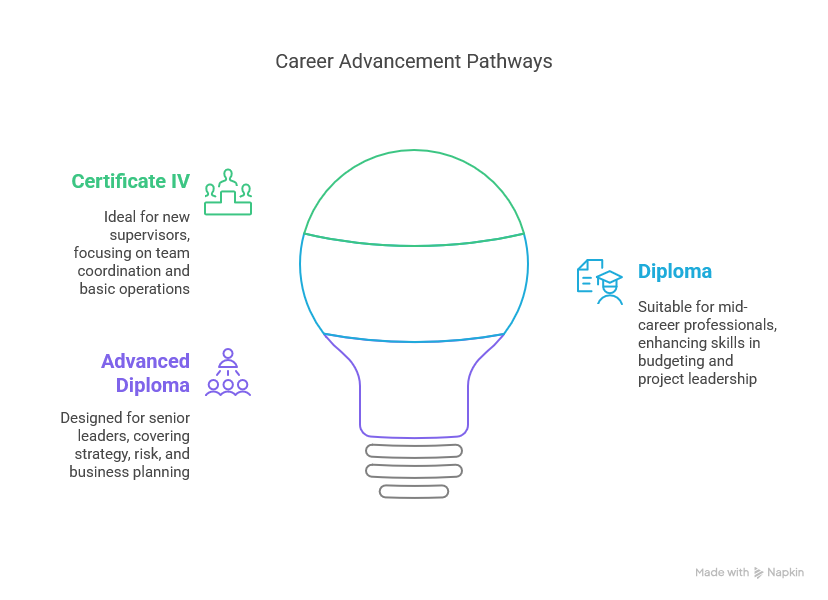
Often considered a stepping stone for those new to formal business training, the Certificate IV focuses on developing foundational supervisory skills, business communication, and office administration. It can be ideal for people shifting from purely hands-on work to roles where they manage small teams or coordinate basic operational tasks. Completion times typically range from 6 to 12 months full-time, though part-time study extends that to 18 months or more.
Diploma of Business (BSB50120) -- AQF Level 5
A Diploma goes further, covering broader operational responsibilities such as project management, risk assessment, budget oversight, and resource coordination. Many professionals pick this qualification to formalise the on-the-job experience they've accumulated or to gain more advanced managerial credibility. Full-time study can take 9 to 12 months, while part-time often stretches to up to 2 years.
Advanced Diploma of Business (BSB60120) -- AQF Level 6
Positioned at a higher level of complexity, the Advanced Diploma targets strategic leadership, high-level business planning, and complex decision-making. Typically completed in 1.5 to 2 years, it suits experienced managers or specialists poised to take on senior operational or strategic roles. Case studies and projects often require evaluating entire business units, steering large teams, or shaping long-term organisational strategies.
Each level assumes a different starting point in terms of existing skills. While you don't necessarily need to begin with a Certificate IV before moving on to a Diploma, RTOs may want to see that you have relevant experience or previous study if you jump directly to a higher-level course. Certain industries also specify which qualification level they prefer for particular jobs, so understanding the differences helps you target your studies efficiently.
Alongside these categories, business qualifications can benefit career changers seeking fresh starts. For instance, someone working in hospitality might shift to a corporate role by acquiring a Certificate IV or Diploma in Business, bridging knowledge gaps in administration or leadership. Ultimately, identifying which scenario reflects your current and future goals helps pinpoint the appropriate AQF level.
Costs, Funding, and Return on Investment
Costs
Tuition fees vary widely. A Certificate IV might cost anywhere from AUD 2,000 to AUD 5,000, a Diploma ranges roughly from AUD 4,000 to AUD 15,000, and an Advanced Diploma can exceed AUD 20,000, especially if it includes specialty electives. Private RTOs often price differently than TAFEs, and your location (metro vs. regional) or eligibility for subsidies can also shift costs.
Funding Options
Many Australian students explore VET Student Loans (formerly known as VET FEE-HELP), which defer payment until your income surpasses a certain threshold. Some states have additional subsidies or concession rates if the course is deemed a priority skill area. If you're employed, ask about professional development funds, as some companies sponsor employees in exchange for a commitment to stay on post-graduation.
ROI and Career Payoff
Holding a formal qualification often boosts earning potential. According to the Department of Employment and Workplace Relations, mid-level managerial roles in Australia can command salaries from AUD 60,000 to AUD 90,000+, depending on the sector and region. Senior management or specialised consulting roles tied to an Advanced Diploma can push beyond AUD 100,000. The intangible benefits—like enhanced confidence, strategic thinking, and credibility—also factor into the return on your educational investment.
That said, a qualification alone doesn't guarantee a promotion or salary bump. You'll need to demonstrate real competence at work. But the structured training ensures you develop (and can prove) the skills employers look for in leadership or administrative capacities. Balancing the upfront cost with the potential long-term gains is a calculation many find worthwhile.
Delivery Methods and Study Modes
A major strength of vocational education in Australia is flexibility. You may choose:
- On-Campus Full-Time: Attend classes and workshops in person. This immersion can speed up course completion but demands a heavier weekly time investment.
- Part-Time or Blended: For those juggling family or job commitments, part-time study offers a reduced load. Many RTOs blend face-to-face sessions with online modules or self-paced materials, accommodating erratic schedules.
- Fully Online: An entirely virtual format can suit remote learners or those who can't commit to campus attendance. You'll usually participate in discussion forums, watch recorded lectures, and submit projects via an online platform. Regular check-ins and digital collaboration replicate some elements of an in-person environment.
Assessments can include writing a comprehensive business plan, creating a budget proposal, conducting a risk assessment, or simulating team leadership in a group project. Some courses expect you to find real-world contexts—like your current job or an internship—to demonstrate competencies.
The time to complete each qualification hinges on your chosen study mode. A Certificate IV might take 6-12 months full-time, a Diploma 9-12 months full-time, and an Advanced Diploma 1.5-2 years, with part-time schedules proportionally longer. Since many providers now offer rolling enrolment periods, you can often begin at a time that suits you rather than waiting for a traditional semester start date.
Potential Career Trajectories
Certificate IV in Business
Graduates frequently find roles as office coordinators, administrative team leaders, or project assistants. While not usually the top rung of management, these jobs provide valuable experience in everyday business operations, from staff scheduling to basic financial processes. Tradespeople may transition off the tools into supervisory positions, bridging their on-site expertise with formal administrative training.
Diploma of Business
Because it covers operational planning, project management, and resource coordination, the Diploma qualifies you for mid-level managerial roles like operations supervisor, department coordinator, or HR manager (in some contexts). If you already have some administrative or leadership background, the Diploma lends formal recognition to your skill set and may open doors to higher pay or new responsibilities.
Advanced Diploma of Business
At this level, you're looking at more strategic or senior roles: business development manager, senior operations manager, or strategic planning consultant. The advanced modules tackle complex problem-solving, risk management, and large-scale project implementation. If you envision yourself guiding organisational policy or leading multiple teams, an Advanced Diploma can position you for these substantial challenges.
Regardless of which qualification you complete, further education remains an option. Some RTOs offer pathways into university degrees, granting credit for completed units. That means you could segue from an Advanced Diploma to a bachelor's degree, cutting down on the overall time and cost of a university education.
Transitioning off the Tools: A Closer Look for Tradespeople
A significant number of business students come from skilled trades backgrounds. After years of physical work—plumbing, electrical, carpentry—they discover that climbing the career ladder often requires stepping into supervisory or managerial roles. While practical site knowledge is invaluable, formal training in budgeting, scheduling, human resources, and compliance can round out these capabilities.
For instance, a tradesperson with a Certificate IV might become a site supervisor, overseeing daily tasks while ensuring safety protocols and project timelines. Someone with a Diploma could progress to operations management, coordinating multiple job sites or teams. An Advanced Diploma might see them leading expansions, negotiating large contracts, or orchestrating entire divisions of a construction company.
If cost is a concern, check whether your state or employer provides funding or scholarships for upskilling. Many industries face a shortage of qualified supervisors who combine hands-on know-how with business literacy, making such cross-trained individuals highly sought after. The move from full-time physical work to a blended office/field role can also reduce wear and tear on your body, prolonging your working years.
Comparing Key Features of Each Level
For a quick reference, here's a snapshot of main differentiators:
BSB40120 Certificate IV in Business
- Level: AQF 4
- Duration: ~6–12 months (full-time)
- Core Skills: Foundational leadership, customer service, simple project tasks, administrative competence
- Ideal Candidate: Those new to business roles, tradespeople moving into office coordination, or anyone who needs an entry-level credential
BSB50120 Diploma of Business
- Level: AQF 5
- Duration: ~9–12 months (full-time, can go up to 24 months part-time)
- Core Skills: Operational management, project coordination, financial oversight, resource planning
- Ideal Candidate: People aiming for mid-level leadership, small business owners needing structured management training, or employees looking to confirm their management capabilities
BSB60120 Advanced Diploma of Business
- Level: AQF 6
- Duration: ~1.5–2 years (full-time)
- Core Skills: Strategic planning, senior leadership, managing complex projects, high-level decision-making
- Ideal Candidate: Experienced managers, professionals eyeing executive or multi-department leadership roles, or those wanting a robust stepping stone to further study (like a bachelor's degree)
Each builds on the previous level's competencies. While direct entry into a Diploma or Advanced Diploma is common for experienced individuals, some prefer a staged approach, starting with a Certificate IV to gain confidence and accumulate credits.
Real-World Applicability and Industry Demand
The practical nature of these qualifications ensures that the skills are directly transferable to real workplaces. Suppose you're studying a unit on project management: you might produce a detailed plan for a hypothetical product launch or service rollout, using the same budgets, timelines, and risk assessments you'll encounter in an actual business. This authenticity not only cements learning but often impresses employers who see immediate relevance.
Recent employment data suggests that roles requiring leadership and business acumen remain in demand, particularly as industries undergo technological changes and need adaptable managers. Whether it's coordinating an online retail shift, implementing new software systems, or simply leading remote teams effectively, the underlying competencies taught in these courses help you handle evolving challenges. Employers appreciate staff who can interpret data, manage people, and implement solutions within compliance guidelines—a capability nurtured by all three qualification levels.
Making Your Final Choice
Deciding which qualification fits you best involves a personal appraisal of your current position, ambitions, and practical constraints. If you're new to management or have limited exposure to business operations, the Certificate IV can provide the basics without overwhelming you. For those with some workplace leadership experience already, the Diploma offers a broader toolkit, making you a strong candidate for departmental roles or project oversight. Meanwhile, the Advanced Diploma is aimed at those who're shaping broader organisational strategy, whether as senior employees or entrepreneurs scaling up their enterprises.
Time and money play a role too. While an Advanced Diploma carries the most weight, it also demands the largest commitment. Some learners prefer to build up from a Diploma, especially if they need to keep working full-time. In some cases, partial or staged study is an option—completing a Diploma first, then continuing later into an Advanced Diploma.
Finally, if you have lingering questions about specific challenges, costs, or outcomes, we have four supporting articles that delve deeper into each qualification and three sub-articles for every supporting article that answer common queries. These references will help you weigh cost structures, the relative difficulty of study, and possible salary ranges after graduation. Consider reading them if you want to be thorough or if you're torn between two levels.
Australian Business Qualifications open doors for people at various stages of their career, from entry-level supervisors to seasoned managers. By connecting theoretical knowledge with practical skills, they equip you to tackle the complexities of a modern workplace. Whether you start at the Certificate IV level or dive straight into an Advanced Diploma, you're investing in a credential that offers credibility and the chance to refine in-demand leadership abilities.
Before enrolling, reflect on your experience, goals, and daily responsibilities. Speak with RTOs, gather details about course outlines, and check if you qualify for any subsidies or recognition of prior learning. It's your future—make an informed choice that aligns with where you are now and where you'd like to be. If you need more detail on the Diploma of Business, the Certificate IV, or the Advanced Diploma, check the supporting articles and their sub-articles for a closer look at real costs, time commitments, and likely career outcomes.
Explore our four supporting articles for deeper insights into specific qualifications. Each includes dedicated sub-articles answering questions on costs, salary, difficulty, and more. Make the choice that aligns with your ambitions and start unlocking new career possibilities.