The article on why Leadership and Management is a strong VET qualification touches on how these two concepts overlap yet diverge. This piece expands that idea by outlining five major differences—helping you pinpoint where your current strengths lie and which areas you may need to develop. Knowing these distinctions clarifies the roles you might aim for or the aspects of your vocational training to emphasize.
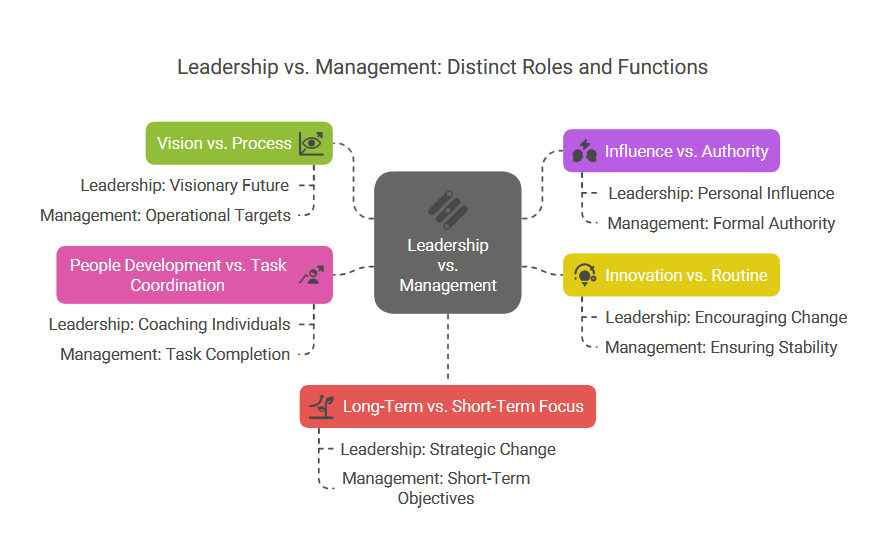
1. Vision vs. Process
Leadership: Leaders articulate a compelling future state, energizing others to believe in and work toward that vision. They deal in abstract ideas, guiding people through uncertainty.
Management: Managers implement the operational steps needed to achieve specific targets, focusing on well-defined tasks, checklists, and procedures.
In VET courses, you'll often study both strategic planning (a leadership trait) and daily operations (a managerial function), reflecting how organisations benefit from each approach.
2. Influence vs. Authority
Leadership: Relies heavily on personal influence, persuasion, and emotional intelligence. Leaders inspire loyalty by resonating with people's values.
Management: Holds formal authority through designated positions. Managers can enforce policies or regulations, often wielding disciplinary power if tasks aren't completed.
While leaders do hold hierarchical power in some cases, pure leadership is more about gaining voluntary buy-in, whereas management can operate through set protocols and job descriptions.
3. Innovation vs. Routine
Leadership: Frequently about change—seeking new horizons, breaking old patterns, and encouraging creative solutions.
Management: Ensures stability and consistency, focusing on refining or maintaining existing processes to ensure predictable outcomes.
Organisations often need both: managers to keep everyday functions stable and leaders to introduce improvements or pivot strategies when required.
4. People Development vs. Task Coordination
Leadership: Deeply invested in personal growth and motivation. Leaders coach individuals, foster culture, and aim to develop future leaders.
Management: Primarily concerned with ensuring tasks are completed efficiently and correctly, often measured through key performance indicators (KPIs) or deadlines.
Though a good manager does consider staff well-being, the emphasis on nurturing talent and personal potential is a hallmark of leadership.
5. Long-Term vs. Short-Term Focus
Leadership: Thinks in terms of sustainable, strategic change, even if immediate outputs are harder to quantify. Leaders lay the groundwork for future success and transformation.
Management: Concentrates on short- to medium-term objectives, meeting monthly targets or quarterly goals.
Depending on your personality, you might prefer the certainty of short-term planning or find greater fulfillment in steering long-range visions.
The Impact on Your Career Development
Understanding these differences can significantly influence how you approach your professional development:
- If you're stronger in managerial tasks but aspire to leadership roles, you might focus your training on developing vision-setting and influence skills.
- If you naturally excel at inspiring others but struggle with operational details, VET courses can help you balance your approach with structured management techniques.
- Recognizing which aspects of your current role lean toward leadership versus management can help you communicate more clearly with superiors about your contributions and growth areas.
Leadership and management aren't synonymous, even though organisations often merge them under a single title. Leaders thrive on vision, innovation, and people development, while managers excel at processes, routine tasks, and short-term execution.
How Leadership and Management Interact in Real Organizations
In practice, most successful professionals develop capabilities in both domains:
- A department head might spend mornings reviewing operational metrics (management) before afternoon sessions developing strategic initiatives with the team (leadership).
- A project manager might create detailed timelines and resource allocations (management) but also inspire team members by connecting their daily tasks to the project's larger impact (leadership).
- Even a frontline supervisor with primarily managerial duties can demonstrate leadership by championing continuous improvement and mentoring new team members.
The most effective organizations foster both skill sets, recognizing that different situations may call for different approaches. A crisis might require decisive managerial coordination, while periods of growth benefit from visionary leadership.
Developing Both Skill Sets Through VET Qualifications
If you're pursuing a Certificate or Diploma in Leadership and Management, you'll find that the curriculum addresses both sides of this equation:
- Units focusing on operational planning and resource allocation develop your management muscles
- Modules on team motivation, coaching, and organizational culture build your leadership capabilities
- Assessment tasks often require you to demonstrate both skill sets, reflecting real-world job demands
By recognizing which aspects come more naturally to you, you can target your development efforts more strategically, ensuring a well-rounded professional profile.
Conclusion
By understanding these five core differences—vision vs. process, influence vs. authority, innovation vs. routine, people vs. tasks, and long-term vs. short-term—you can better assess where your strengths might be best applied and where you might want additional training.
In practical terms, a certificate or diploma in Leadership and Management tends to address both sets of skills, reflecting how modern workplaces benefit from individuals who can handle day-to-day demands while also nurturing a compelling direction. Identifying which aspects resonate most with you can guide your choices of electives, specializations, or subsequent qualifications, ensuring you grow in a way that aligns with your career goals.