Australian Business Qualifications open doors to a spectrum of roles, from basic administrative coordination to senior strategic management. Yet each AQF level aligns best with certain responsibilities and career paths. This article outlines the typical job titles and duties you can expect at the Certificate IV, Diploma, and Advanced Diploma levels, giving you a clearer roadmap of where each qualification can take you. Whether you're a hands-on worker aiming for a small leadership role or a seasoned manager targeting executive decisions, you'll see how each certificate or diploma helps you land relevant roles in various industries.
Certificate IV in Business: Entry-Level Supervision
Common Roles:
- Team leader
- Office coordinator
- Project assistant
- Customer service supervisor
- Administrative team leader
Main Duties: Overseeing daily schedules, handling minor staff issues, basic administrative tasks, ensuring compliance with straightforward policies
A Certificate IV is often the first step into formal leadership. If you've never led a team or handled administrative processes, it introduces you to fundamental principles of communication, organisation, and small-scale project coordination. Job adverts might list "Certificate IV in Business or equivalent experience" as a requirement, signalling that the employer values structured administrative or supervisory knowledge. In large organisations, these roles often feed into more advanced career tracks once you gain enough experience and perhaps move on to a Diploma.
Diploma of Business: Mid-Level Management
Common Roles:
- Operations manager
- Project coordinator
- Departmental supervisor
- HR officer (with relevant electives)
- Business development executive
Main Duties: Resource allocation, budgeting, risk assessment, leading mid-sized teams or a department, coordinating multiple tasks or short-term projects
The Diploma is where you step into broader oversight. You're expected to juggle more complex tasks—like strategic budget planning, performance metrics, and risk mitigation. If your previous background includes some leadership experience, a diploma cements your ability to organise bigger or more diverse teams. Industries that frequently recruit diploma holders include healthcare administration, retail management, and construction project supervision. The scope is narrower than what advanced diploma holders do, but it still carries substantial responsibility, often translating into a noticeable pay increase over Certificate IV positions.
Advanced Diploma of Business: Senior Leadership and Strategy
Common Roles:
- Senior operations manager
- Business development manager
- Strategic planning consultant
- Project director
- Business unit leader
Main Duties: Company-wide strategy, large-scale project execution, cross-functional leadership, advanced risk management, driving innovation
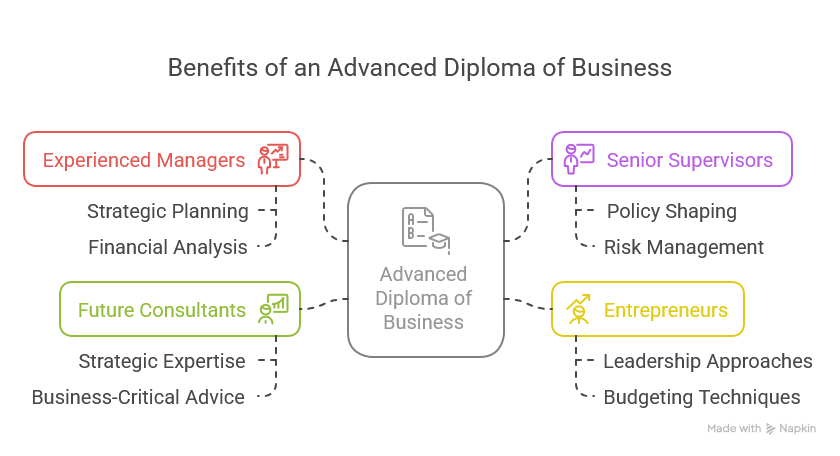
When you hold an Advanced Diploma, employers expect you to operate at a strategic level—spotting growth opportunities, steering multiple departments, or advising leadership on reorganisation or expansion. It's less about routine tasks and more about shaping long-term success. Sectors such as finance, technology, and major construction projects often want advanced-level skill sets for roles that pay above AUD 90,000 or even six figures, depending on complexity. Some advanced diploma graduates also pivot into consultancy, using their high-level acumen to guide smaller businesses or start-ups in scaling operations effectively.
Industry Variations
While these qualifications are widely recognised, each sector has nuances:
Trades and Construction
- Certificate IV: Site supervisor, team leader, administrative coordinator
- Diploma: Project manager, operations coordinator, contracts administrator
- Advanced Diploma: Regional operations manager, business development manager, strategic planning director
Retail and Hospitality
- Certificate IV: Store manager, shift supervisor, customer service team leader
- Diploma: Area manager, operations supervisor, training coordinator
- Advanced Diploma: Regional director, business expansion specialist, strategic operations manager
Professional Services and Corporate
- Certificate IV: Office manager, administrative coordinator, team leader
- Diploma: Department manager, project coordinator, executive assistant
- Advanced Diploma: Business unit manager, strategic consultant, senior project director
Regardless of industry, each qualification tier adds layers of responsibility and complexity, aligning with the broad guidelines of the AQF.
Mapping Your Career Progression
Starting at Certificate IV
Ideal if you lack formal business training or want a basic supervisory role. You can later articulate into a diploma once comfortable. Gaining real-world practice while studying ensures you consolidate those fundamental leadership skills. Many Certificate IV graduates find roles as team leaders or coordinators, developing the confidence to handle small teams and administrative processes.
Transitioning to a Diploma
Perfect for mid-career professionals or those who've outgrown entry-level administration. You'll oversee budgets, staff rosters, and short-term project goals. Promotion prospects often open up, with salaries stepping into higher brackets. Diploma graduates frequently take on department management roles or specialized positions that require broader business understanding.
Advancing to an Advanced Diploma
Suited to those who aspire to lead entire departments, handle multi-year projects, or shape company strategy. It can also lead to partial credit in university degrees if you want to keep studying. Positions you as a key decision-maker, potentially bridging into executive discussions. Advanced Diploma holders often become the strategic thinkers in their organizations, guiding long-term planning and major initiatives.
This structured pathway ensures you won't attempt advanced tasks prematurely or remain stuck in low-responsibility roles longer than necessary. Each qualification level supports a logical career jump, letting you develop competencies that match your workplace realities.
From entry-level leadership (Certificate IV) to middle management (Diploma) and onto senior strategic roles (Advanced Diploma), Australian Business Qualifications cater to varied professional stages. By matching your background and aspirations with the right AQF level, you can step into roles that harness your skills effectively while paving the way for future growth.